
Forestry Undergrowth & Firebreak Management
Forestry Undergrowth & Firebreak Management
Forestry Undergrowth & Firebreak Management
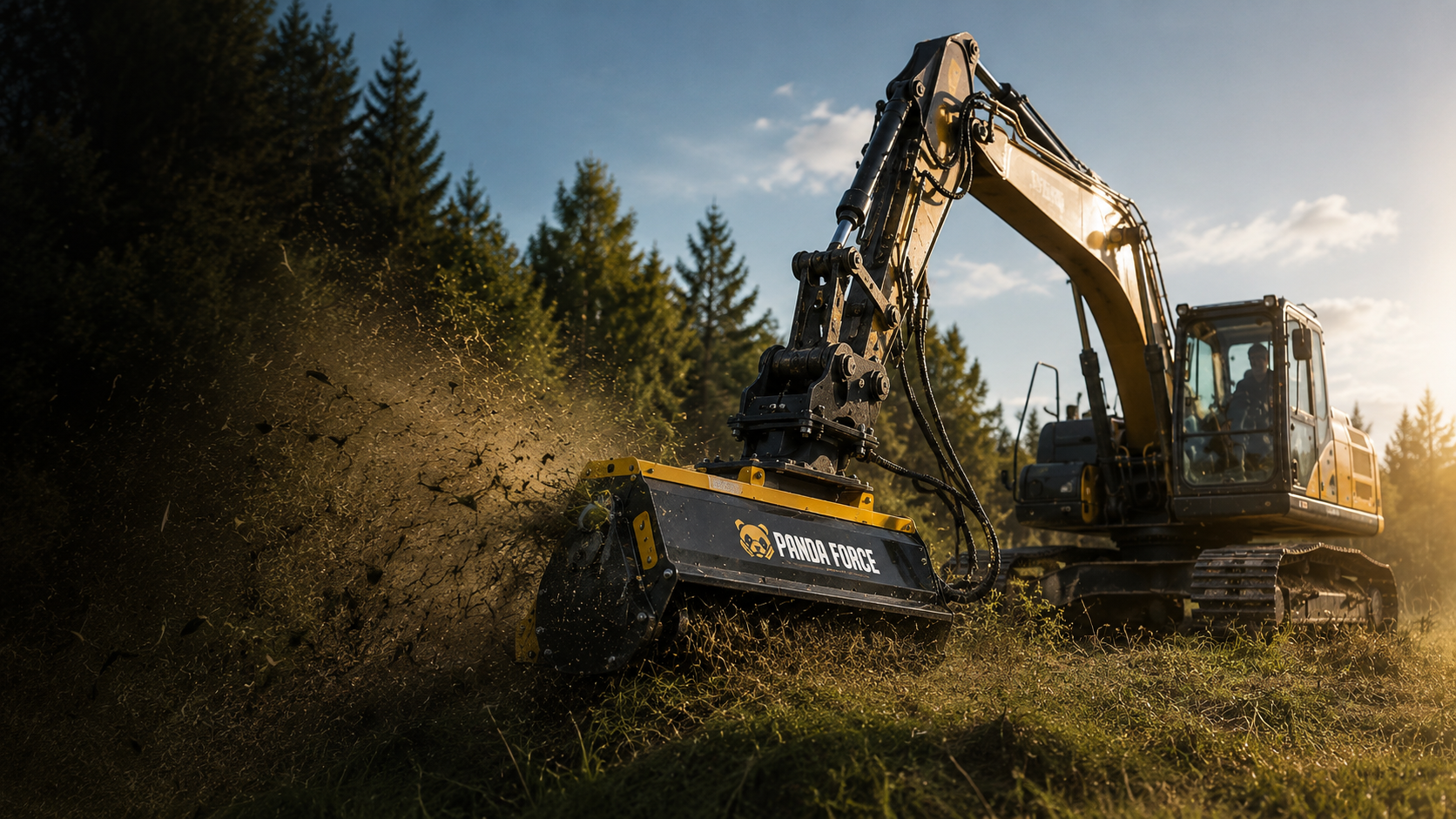
Excavator flail mower solutions for forestry contractors, woodland managers and conservation organisations managing undergrowth, firebreaks, invasive species and forest floor vegetation.
PANDA FORCE · SOOSAN Manufacturing · CE Marked · ISO 9001
Application Overview
Excavator Flail Mowers in Forestry: Undergrowth Control, Firebreaks and Invasive Species
Forestry and woodland management presents some of the most demanding conditions for vegetation management equipment. Dense undergrowth, woody scrub, invasive species and the requirement to work on steep terrain with limited access all place extreme demands on the attachment and the machine. PANDA FORCE forestry flail mowers are designed specifically for these conditions.
The primary forestry applications for excavator-mounted flail mowers are undergrowth management in plantation forestry, firebreak clearance and maintenance, invasive species removal (particularly rhododendron, cherry laurel and sycamore regeneration), and woodland ride and track edge management. In each case, the excavator-mounted flail mower offers advantages over tractor-based or manual methods that are difficult to replicate with any other equipment type.
In plantation forestry, undergrowth management between crop rows is critical for crop tree development. Dense bramble, bracken and scrub competes with crop trees for light and nutrients, and provides cover for deer and rabbits that browse young trees. Excavator-mounted flail mowers can work between crop rows at spacings as narrow as 2.5m, mulching undergrowth at ground level without damaging crop trees. The mulch output improves forest floor organic matter and eliminates the need for burning or off-site disposal.
Firebreak maintenance is a critical application in fire-prone regions of Southern Europe, Australia and the western United States. Firebreaks must be kept clear of combustible vegetation to function effectively. PANDA FORCE forestry flail mowers process dense scrub and woody growth into fine mulch, reducing the combustible material load on the firebreak surface. The mulch decomposes rapidly, further reducing fire risk compared to cut material left in windrows.
Invasive species removal — particularly rhododendron ponticum in the UK and Ireland, and various invasive scrub species in other markets — is a major application for forestry flail mowers. Rhododendron forms dense thickets that shade out native woodland flora and prevent natural regeneration. Excavator-mounted flail mowers can process rhododendron stems up to 150mm diameter (with the forestry-specification PF-FFM model) and reduce the material to mulch in a single pass, significantly reducing the cost of subsequent herbicide treatment.
PANDA FORCE forestry flail mowers are manufactured by SOOSAN Heavy Industries Co., Ltd. to ISO 9001:2015 quality standards. The PF-FFM forestry model features a reinforced rotor drum, heavy-duty hammer flails and Hardox 500 wear plates — the highest specification in the PANDA FORCE range — designed for the extreme demands of forestry undergrowth clearance.
Typical Working Conditions
Product Recommendation
Recommended PANDA FORCE Models
The following PANDA FORCE flail mower and brush cutter models are recommended for this application based on working width requirements, excavator weight class, hydraulic specification and blade type.
PANDA FORCE PF-FFM Forestry Flail Mower
PrimaryThe PF-FFM is the primary specification for forestry undergrowth clearance. Reinforced rotor drum, heavy-duty hammer flails and Hardox 500 wear plates are designed for the extreme demands of dense scrub and woody undergrowth. Handles stems up to 150mm diameter.
View Full SpecificationPANDA FORCE PF-HDF Heavy Duty Flail Mower
For large-scale forestry clearance and firebreak maintenance where maximum productivity is required. The 2,000–2,200mm working width significantly reduces the number of passes on wide firebreaks. Specified for large excavators on major forestry contracts.
View Full SpecificationPANDA FORCE PF-HFM High-Flow Flail Mower
For forestry applications where a high-flow excavator is available but the full forestry specification of the PF-FFM is not required. Suitable for lighter undergrowth and woodland ride management where vegetation density is moderate.
View Full SpecificationBlade Selection
Recommended Blade Types
Heavy hammer flail is the standard specification for forestry undergrowth clearance. The high blade mass (typically 2.5–4.0 kg per blade) stores sufficient kinetic energy to process woody stems up to 100–150mm diameter without stalling. Forged 42CrMo4 alloy steel, heat-treated to 45–50 HRC, provides the impact resistance required for repeated contact with woody material.
Carbide-tipped flails are specified for stony woodland where standard hammer flails wear rapidly. The tungsten carbide tip inserts extend replacement intervals to 600–1,200 ha in abrasive conditions — significantly longer than standard steel flails. Specified for rocky woodland in upland areas and sites with significant stone content.
Y-blades and knife blades are not suitable for forestry undergrowth clearance. The lighter blade mass is insufficient to process woody stems above 40mm diameter without stalling. Y-blades will be rapidly damaged by contact with woody material and will require frequent replacement, increasing operating cost significantly.
Hydraulic Specification
Hydraulic Requirements
Forestry flail mowers require higher hydraulic flow than standard models due to the greater power demand of processing dense woody material. Most 15–25 tonne excavators provide 100–160 L/min auxiliary flow. Verify your excavator's high-flow auxiliary circuit specification before ordering. The PF-FFM and PF-HDF models require high-flow auxiliary circuits — standard auxiliary circuits on smaller excavators are insufficient.
Real-World Use Cases
Before & After: Contractor Use Cases
The following use cases are based on real contractor and operator scenarios from PANDA FORCE customers across Europe, North America and Australia. Each describes the challenge, the solution specified and the measurable result.
Rhododendron Clearance — Scottish Highland Estate
A Scottish Highland estate needed to clear 45 hectares of rhododendron ponticum from native woodland. Rhododendron stems ranged from 30mm to 180mm diameter, with canopy heights of 3–5m. Previous clearance attempts using manual chainsaws and brushcutters had been slow and expensive.
Manual clearance cost £3,200/ha and required significant herbicide follow-up treatment. The dense canopy and steep terrain made tractor access impossible. Burning of cut material was prohibited due to proximity to a Site of Special Scientific Interest.
Specified PANDA FORCE PF-FFM-1500 on a 22t excavator. Heavy hammer flails processed rhododendron stems up to 150mm diameter in a single pass. Mulch output eliminated burning requirement. Herbicide treatment applied to cut stumps immediately after mulching.
Clearance cost reduced to £1,450/ha — 55% saving over manual methods. 45 ha cleared in 18 working days. Mulch output improved forest floor conditions for native species regeneration. Herbicide treatment cost reduced by 30% due to improved stump access.
Firebreak Maintenance — Portuguese State Forest
A Portuguese state forestry agency needed to maintain 380 km of firebreaks in eucalyptus and pine plantation. Firebreaks were 8–12m wide and required annual clearance of dense regrowth including eucalyptus coppice shoots, gorse and broom.
Annual regrowth on firebreaks was dense and fast-growing, reaching 2–3m height within 12 months of clearance. Tractor-mounted equipment was unable to work on the steep terrain adjacent to many firebreaks. Fire risk was increasing due to incomplete clearance.
Specified PANDA FORCE PF-FFM-2000 on a 30t excavator. The 2,000mm working width cleared the full firebreak width in 2–3 passes. Heavy hammer flails processed eucalyptus coppice shoots up to 80mm diameter. Mulch output reduced combustible material accumulation.
Firebreak clearance productivity: 4.2 km/day. Annual clearance programme completed 3 weeks ahead of schedule. Combustible material load on firebreak surface reduced by 70% compared to cut-and-leave method. Zero fire incidents on maintained firebreaks during the following fire season.
Plantation Undergrowth Management — Irish Commercial Forestry
An Irish commercial forestry company needed to manage undergrowth in 1,200 ha of Sitka spruce plantation at the 5–8 year stage. Dense bracken, bramble and grass competition was suppressing crop tree growth and increasing deer browsing pressure.
Tractor-mounted equipment could not access the plantation due to the narrow spacing between crop rows (2.5m). Manual brushcutting was too slow and expensive for the area involved. Herbicide treatment was restricted due to proximity to watercourses.
Specified PANDA FORCE PF-FFM-1000 on a 15t excavator. The 1,000mm working width allowed the attachment to work between crop rows at 2.5m spacing without crop tree damage. Y-blade configuration used for bracken and grass; switched to hammer flail for bramble and woody growth.
Undergrowth management cost reduced by 45% compared to manual methods. 1,200 ha treated in one season. Crop tree growth rate increased by an estimated 15–20% in treated areas. Deer browsing pressure reduced due to elimination of dense cover.
Operational Performance
Productivity Benefits
Dense scrub and undergrowth clearance with PF-FFM-1500 on 22t excavator. Productivity varies with stem density and diameter.
8–12m wide firebreak clearance with PF-FFM-2000 on 30t excavator. Productivity on annual regrowth clearance.
Compared to manual chainsaw and brushcutter methods on equivalent areas. Saving increases with scale of operation.
Mulching action eliminates burning, chipping and off-site disposal. Critical where burning is prohibited near sensitive habitats.
Mulching at ground level suppresses regrowth and improves herbicide treatment access, reducing overall herbicide programme cost.
PF-FFM forestry model with heavy hammer flails. Handles the full range of undergrowth and scrub encountered in managed woodland.
Operator Safety
Safety Considerations
Safe operation of excavator flail mower attachments requires adherence to the operator manual, relevant national regulations and site-specific risk assessments. The following points are specific to this application environment. They do not replace the full safety documentation supplied with each unit.
Overhead Hazards
- Assess overhead canopy height before commencing work — minimum 1m clearance above attachment at maximum arm height
- Identify and mark any overhead power lines or telecommunications cables before work begins
- Reduce arm speed when working near overhead obstructions
- Stop work if unexpected overhead hazards are encountered
Stem Ejection
- Maintain minimum 30m exclusion zone around the working attachment in all directions
- Do not allow personnel in the exclusion zone while the rotor is running
- Reduce rotor speed when processing large-diameter stems to reduce ejection risk
- Inspect rear deflector before each shift — replace if worn or damaged
Machine Stability
- Assess ground bearing capacity before positioning excavator on forest floor
- Use timber mats or ground protection where ground is soft or waterlogged
- Do not work on slopes exceeding the excavator manufacturer's rated working gradient
- Reduce working speed on slopes and uneven terrain
Wildlife & Environment
- Conduct ecological survey before commencing clearance in sensitive woodland
- Avoid work during nesting season (March–August) unless ecological survey confirms absence of nesting birds
- Check for bat roosts in trees adjacent to working area
- Prevent hydraulic oil contamination of watercourses — have spill kit on site
Fire Risk
- In fire-prone regions, check fire risk index before commencing work
- Do not work in high fire risk conditions — hot, dry, windy weather
- Have fire extinguisher on the excavator and a water source accessible
- Mulch output reduces fire risk compared to cut material in windrows — but monitor mulch temperature in hot conditions
Hydraulic Safety
- Allow rotor to stop completely before repositioning or transporting attachment
- Inspect hydraulic hoses for abrasion damage from woody debris — replace any damaged hose
- Do not operate with hydraulic leaks in woodland — risk of hydraulic oil fire on hot exhaust components
- Maintain hydraulic oil temperature below 80°C
Service & Maintenance
Maintenance Schedule
Correct maintenance is the single most important factor in attachment service life and operating cost. The following schedule is specific to this application environment. Refer to the operator manual for the full maintenance programme and torque specifications.
- Inspect all flail blades for damage — replace any blade with visible cracks
- Check rear deflector condition and fit
- Grease rotor bearing nipples (2 pumps each)
- Inspect hydraulic hoses for abrasion from woody debris
- Clear any debris accumulation from rotor area
- Check hydraulic connections for leaks
- Inspect all flail blades and carrier pins for wear
- Check blade retention bolt torque
- Inspect Hardox wear plates for wear — replace when worn to minimum thickness
- Check rotor drum for cracks or damage
- Inspect mounting bracket for cracks or wear
- Check hydraulic motor case drain connection
- Replace worn or damaged flail blades — replace as complete set for balance
- Rotor bearing temperature check after 30-min run
- Inspect all welds for cracking — particularly rotor drum end plates
- Check hydraulic relief valve setting
- Inspect and clean hydraulic filter
- Check all fastener torques
- Full blade set replacement if wear exceeds 20% of original mass
- Rotor dynamic balance check if vibration has increased
- Full hydraulic system flush and filter replacement
- Repaint worn areas — Hardox wear plates are unpainted but housing requires protection
- Full inspection and service record update
Technical FAQ
Frequently Asked Questions
Technical questions specific to this application. For general product questions, visit the individual product pages or the Knowledge Center.
PANDA FORCE Product Range
Excavator Flail Mower & Attachment Range
PANDA FORCE manufactures six excavator attachment models covering every weight class from 1.5 to 50 tonnes. Each product page includes full specifications, hydraulic requirements, compatible excavator brands and blade selection guides.
Ready to Specify for Forestry Undergrowth & Firebreak Management?
Contact our technical sales team for a model recommendation, compatibility check and competitive quote for your application.