
Solar Farm Vegetation Management
Solar Farm Vegetation Management
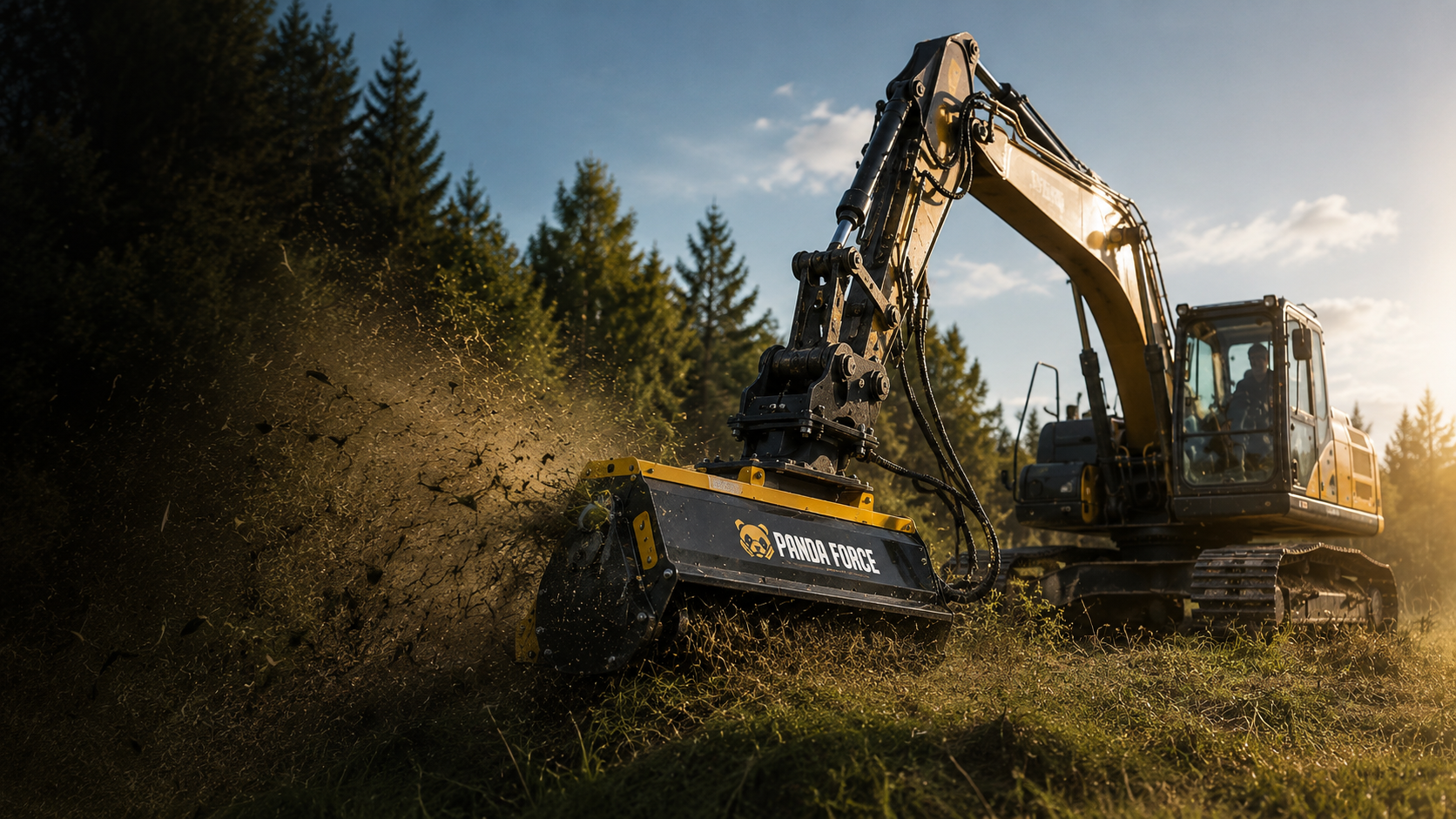
Solar Farm Vegetation Management
Excavator flail mower solutions for solar farm O&M contractors, landowners and vegetation management companies maintaining panel row corridors, perimeter fences, access roads and inverter station areas.
PANDA FORCE · SOOSAN Manufacturing · CE Marked · ISO 9001
Application Overview
Vegetation Management on Solar Farms: Panel Row Corridors, Perimeters and Access Roads
Solar farm vegetation management is one of the fastest-growing applications for excavator-mounted flail mowers. The rapid expansion of utility-scale solar installations across Europe, North America and Australia has created a significant demand for vegetation management equipment that can work safely around solar panel arrays without risk of panel damage.
The key challenge in solar farm vegetation management is the combination of restricted working height (panel undersides are typically 0.6–1.2m above ground level), narrow working corridors between panel rows (typically 2.5–5.0m), and the requirement to avoid any contact with panel frames, mounting structures and electrical cabling. Conventional tractor-mounted equipment is poorly suited to this environment — the tractor itself is too tall to work under panel arrays, and the working width of standard flail mowers is too wide for narrow panel row corridors.
PANDA FORCE mini and compact excavator flail mowers are designed for this application. The compact profile of the PF-MEF mini series (attachment height 400–500mm) allows working under panel arrays with undersides as low as 600mm. The precise arm positioning of an excavator allows the operator to work in narrow corridors without risk of panel contact, and to stop immediately if an obstacle is encountered.
Solar farm vegetation management has two distinct zones with different requirements. The panel row corridors require compact, low-profile equipment with precise positioning control. The perimeter fence lines, access roads and inverter station areas can accommodate larger equipment and require higher productivity to manage the greater area involved. PANDA FORCE offers models for both zones — the PF-MEF mini series for panel row corridors and the PF-EFM or PF-HFM for perimeter and access road management.
The mulching action of a flail mower is particularly important in solar farm applications. Cut material must not be left in windrows that could create fire risk or obstruct drainage. Fine mulch from a PANDA FORCE flail mower falls back onto the ground surface and decomposes rapidly, eliminating fire risk and maintaining drainage function. This is a significant advantage over rotary cutters and brush cutters that leave cut material in windrows.
PANDA FORCE flail mowers are manufactured by SOOSAN Heavy Industries Co., Ltd. to ISO 9001:2015 quality standards. All models are CE marked and supplied with full documentation. The range is available in working widths from 600mm to 2,000mm, covering all solar farm vegetation management requirements from narrow panel row corridors to wide perimeter areas.
Typical Working Conditions
Product Recommendation
Recommended PANDA FORCE Models
The following PANDA FORCE flail mower and brush cutter models are recommended for this application based on working width requirements, excavator weight class, hydraulic specification and blade type.
PANDA FORCE PF-MEF Mini Excavator Flail Mower
PrimaryPrimary specification for panel row corridor management. Compact profile (400–500mm height) allows working under panel arrays. Precise arm positioning prevents panel contact. Y-blade for grass management; knife blade for wildflower mix management requiring fine mulch output.
View Full SpecificationPANDA FORCE PF-EFM Excavator Flail Mower
For perimeter fence line, access road and inverter station area management where higher productivity is required. Y-blade for maintained grass areas; hammer flail for dense scrub on perimeter fence lines.
View Full SpecificationPANDA FORCE PF-HFM High-Flow Flail Mower
For solar farm perimeters with dense scrub and woody growth that has accumulated over multiple seasons. High-flow motor maintains rotor speed on dense vegetation without stalling — critical for productivity on large perimeter management contracts.
View Full SpecificationBlade Selection
Recommended Blade Types
Y-blade is the standard specification for solar farm grass management. Suitable for panel row corridor management and perimeter grass areas. Fine mulch output falls back onto the ground surface, eliminating fire risk and maintaining drainage. Many solar farms use wildflower seed mixes — Y-blade produces fine mulch that allows wildflower regeneration after cutting.
Knife blade is specified where solar farm operators require the finest possible mulch output — particularly on sites with wildflower seed mixes where mulch quality affects wildflower regeneration. Also suitable for solar farms where the O&M contract specifies a fine finish standard.
Hammer flail is not recommended for panel row corridor management. The high impact energy of hammer flails increases the risk of stone ejection that could damage panel undersides. Use Y-blade or knife blade in panel row corridors. Hammer flail is acceptable for perimeter fence line management away from panel arrays.
Hydraulic Specification
Hydraulic Requirements
Panel row corridor management uses mini excavators (1.5–6t) providing 20–55 L/min, suitable for PF-MEF mini series. Perimeter management uses medium excavators (8–18t) providing 80–150 L/min, suitable for PF-EFM standard range. Verify your excavator's auxiliary flow rate before specifying. All hydraulic connections must be inspected for leaks before working near solar panel arrays — hydraulic oil contamination of panel surfaces reduces energy output.
Real-World Use Cases
Before & After: Contractor Use Cases
The following use cases are based on real contractor and operator scenarios from PANDA FORCE customers across Europe, North America and Australia. Each describes the challenge, the solution specified and the measurable result.
Panel Row Corridor Management — 50 MW Solar Farm, UK
A 50 MW solar farm in the East Midlands with 180,000 panels on 120 ha needed to manage vegetation in panel row corridors throughout the growing season. Panel undersides were 0.8m above ground level and corridor width was 3.0m. The site used a wildflower seed mix for biodiversity benefit.
Tractor-mounted equipment was too tall to work under panel arrays. Conventional flail mowers were too wide for 3.0m corridors. The wildflower seed mix required fine mulch output to allow wildflower regeneration after cutting. Manual strimming was too slow and expensive for 120 ha.
Specified PANDA FORCE PF-MEF-800 with knife blades on a 3t mini excavator. The 800mm working width and 450mm attachment height allowed working in 3.0m corridors under 0.8m panel undersides. Knife blade produced fine mulch for wildflower regeneration.
Full 120 ha managed in 3 cutting cycles per season. Wildflower mix maintained — biodiversity benefit preserved. Annual vegetation management cost reduced by 55% compared to manual strimming. Zero panel damage incidents.
Perimeter Scrub Management — 80 MW Solar Farm, Australia
An 80 MW solar farm in New South Wales needed to manage dense scrub and woody growth on 12 km of perimeter fence line. Scrub had accumulated over 4 years since construction and included native species up to 60mm diameter. Fire risk was a significant concern during the Australian summer.
Dense scrub on the perimeter fence line was creating a fire risk and reducing the effectiveness of the security fence. Tractor-mounted equipment could not work on the uneven terrain adjacent to the fence line. Manual clearance was too slow and expensive for 12 km of perimeter.
Specified PANDA FORCE PF-HFM-1300 with hammer flail on a 16t excavator. The high-flow motor maintained rotor speed on dense native scrub. Mulch output eliminated fire risk from cut material in windrows.
Perimeter clearance completed in 8 working days. Fire risk eliminated — mulch decomposed within 6 weeks. Security fence visibility restored. Annual perimeter management programme established at 2 cuts per year.
Inverter Station Area Management — 30 MW Solar Farm, Germany
A 30 MW solar farm in Bavaria needed to manage vegetation around 8 inverter stations and the site substation. Areas included gravel pads, grass margins and access roads. Vegetation management was required 4 times per year to comply with grid operator requirements.
Inverter station areas contained a mix of gravel pads, grass margins and concrete surfaces. Conventional mowing equipment could not work on gravel pads. Manual strimming was required for areas around electrical equipment. Compliance with grid operator vegetation management requirements was mandatory.
Specified PANDA FORCE PF-MEF-900 with Y-blade on a 3.5t mini excavator. The compact machine worked around inverter station structures and electrical equipment. Y-blade managed grass margins without disturbing gravel pads.
Grid operator vegetation management requirements met. Annual management cost reduced by 35% compared to manual methods. All 4 annual cuts completed within programme. Zero electrical incidents.
Operational Performance
Productivity Benefits
Panel row corridor management with PF-MEF-800 on 3t mini excavator. Productivity varies with corridor width and vegetation density.
Perimeter fence line management with PF-EFM-1200 on 14t excavator. Productivity on established grass and light scrub.
Mulching action eliminates cut material in windrows — the primary fire risk on solar farm sites during dry conditions.
Precise arm positioning and Y-blade specification minimise stone ejection risk to panel undersides.
Fine mulch output from knife blade or Y-blade allows wildflower regeneration after cutting — biodiversity benefit preserved.
Compared to manual strimming on equivalent areas. Saving increases with site size and number of annual cuts.
Operator Safety
Safety Considerations
Safe operation of excavator flail mower attachments requires adherence to the operator manual, relevant national regulations and site-specific risk assessments. The following points are specific to this application environment. They do not replace the full safety documentation supplied with each unit.
Electrical Safety
- All work must comply with the site electrical safety procedures and permit-to-work system
- Maintain minimum 1m clearance between attachment and all electrical equipment, cabling and panel frames
- Do not work near electrical equipment in wet conditions without specific risk assessment
- Stop work immediately if any electrical equipment is damaged — isolate and report before continuing
Panel Protection
- Maintain minimum 300mm clearance between attachment and panel undersides at all times
- Use Y-blade or knife blade in panel row corridors — not hammer flail
- Reduce arm speed when working close to panel arrays
- Inspect rear deflector before each shift — replace if worn or damaged
Fire Risk
- Do not work in high fire risk conditions — hot, dry, windy weather
- Mulch output must fall back onto the ground surface — do not allow cut material to accumulate on panel surfaces
- Have fire extinguisher on the excavator and a water source accessible
- Comply with site fire management plan requirements
Machine Stability
- Assess ground bearing capacity before positioning excavator on solar farm ground
- Do not work on slopes exceeding the excavator manufacturer's rated working gradient
- Use designated access routes — do not drive across panel mounting structures
- Reduce working speed on uneven terrain and slopes
Hydraulic Safety
- Inspect hydraulic hoses for leaks before working near solar panel arrays
- Hydraulic oil contamination of panel surfaces reduces energy output — clean immediately if contamination occurs
- Do not operate with hydraulic leaks near electrical equipment
- Maintain hydraulic oil temperature below 80°C
Wildlife
- Many solar farms have biodiversity management plans — check requirements before commencing work
- Avoid mowing during nesting season (March–August) unless ecological survey confirms absence of nesting birds
- Check for ground-nesting birds before commencing work on wildflower areas
- Comply with biodiversity management plan requirements for timing and frequency of cutting
Service & Maintenance
Maintenance Schedule
Correct maintenance is the single most important factor in attachment service life and operating cost. The following schedule is specific to this application environment. Refer to the operator manual for the full maintenance programme and torque specifications.
- Inspect flail blades for damage — replace any blade with visible cracks
- Check rear deflector condition and fit
- Grease rotor bearing nipples (2 pumps each)
- Check hydraulic connections for leaks — critical near electrical equipment
- Clear any vegetation accumulation from rotor area
- Check hydraulic hose condition
- Inspect all flail blades and carrier pins for wear
- Check blade retention bolt torque
- Inspect side wear plates for wear
- Check rear deflector mounting bolts
- Inspect quick coupler interface for wear
- Check hydraulic motor case drain connection
- Replace worn or damaged flail blades
- Rotor bearing temperature check after 30-min run
- Inspect all welds for cracking
- Check hydraulic relief valve setting
- Inspect mounting bracket for cracks or wear
- Clean and inspect hydraulic filter
- Full blade set replacement at end of season if wear exceeds 20%
- Full hydraulic system flush and filter replacement
- Repaint worn areas to prevent off-season corrosion
- Full inspection and service record update
- Review blade type selection for following season
- Check CE marking label condition
Technical FAQ
Frequently Asked Questions
Technical questions specific to this application. For general product questions, visit the individual product pages or the Knowledge Center.
PANDA FORCE Product Range
Excavator Flail Mower & Attachment Range
PANDA FORCE manufactures six excavator attachment models covering every weight class from 1.5 to 50 tonnes. Each product page includes full specifications, hydraulic requirements, compatible excavator brands and blade selection guides.
Ready to Specify for Solar Farm Vegetation Management?
Contact our technical sales team for a model recommendation, compatibility check and competitive quote for your application.