
Orchard & Vineyard Floor Management
Orchard & Vineyard Floor Management
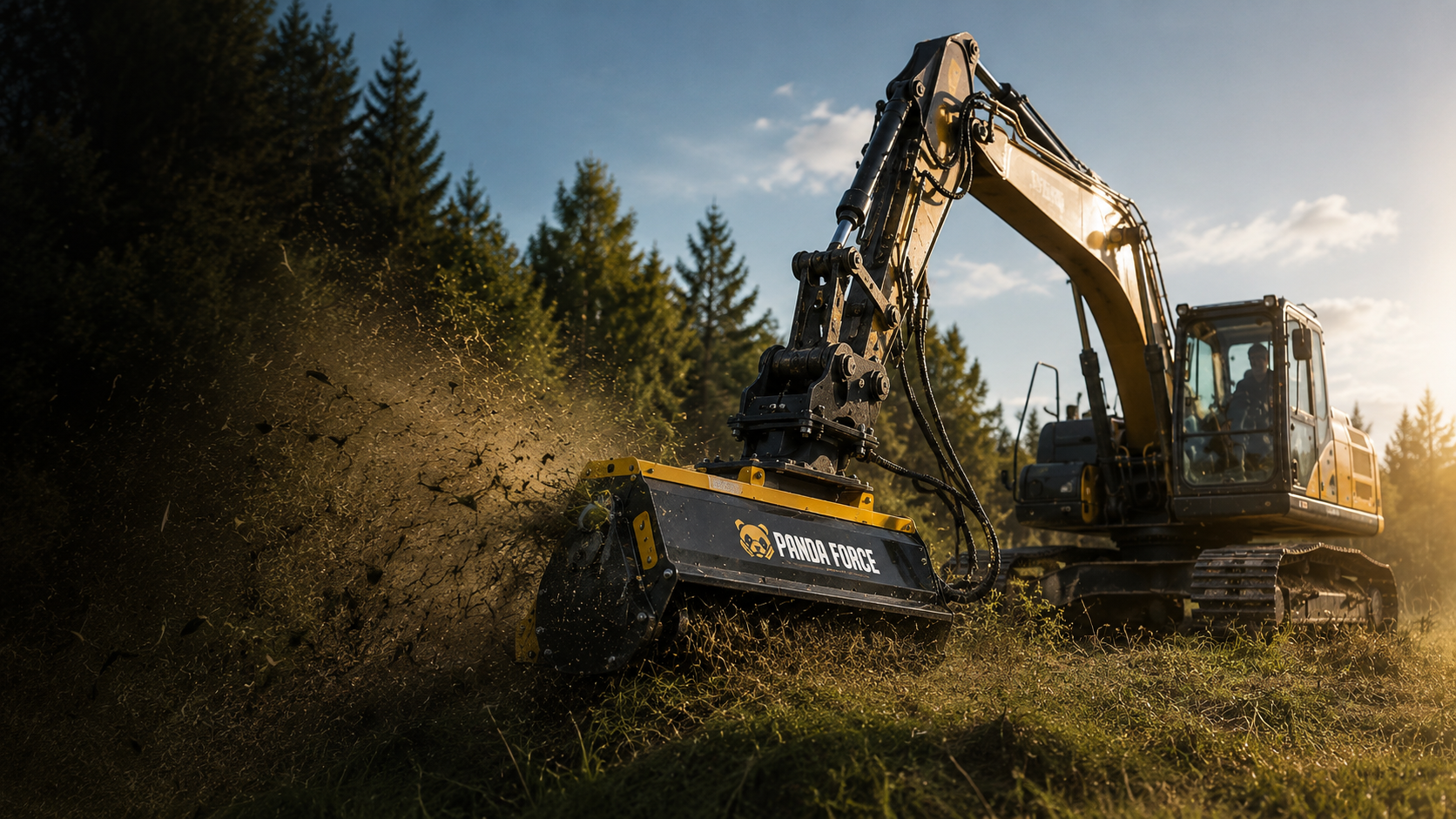
Orchard & Vineyard Floor Management
Excavator flail mower solutions for fruit growers, vineyard managers and horticultural contractors managing inter-row vegetation, under-canopy growth and orchard floor conditions.
PANDA FORCE · SOOSAN Manufacturing · CE Marked · ISO 9001
Application Overview
Precision Vegetation Management for Orchards, Vineyards and Soft Fruit Plantations
Orchard and vineyard floor management is one of the most precision-demanding applications for excavator-mounted flail mowers. The combination of narrow row spacings, sensitive root systems, low canopy heights and the requirement for fine mulch output makes it an application where equipment selection and operator skill are both critical.
PANDA FORCE mini and compact excavator flail mowers are designed for this application. The compact dimensions of the PF-MEF mini series allow working in vine rows as narrow as 1.2m, while the precise arm positioning of an excavator allows cutting at tree and vine bases without bark damage — something that is not possible with tractor-mounted equipment.
The key advantage of an excavator-mounted flail mower over tractor-mounted equipment in orchards and vineyards is the combination of low ground pressure and precise arm positioning. Tractor-mounted equipment compacts the soil between rows, damaging the fine root systems that are critical for fruit quality and yield. An excavator working from the headland or a designated access route can reach into the rows without the machine entering the growing area.
Mulch quality is particularly important in orchard and vineyard applications. The fine mulch produced by a flail mower with knife blades decomposes rapidly, improving soil organic matter and moisture retention. This is particularly valuable in dry climates where soil moisture conservation is critical for fruit quality. The mulch also suppresses weed germination, reducing herbicide requirements.
PANDA FORCE flail mowers are manufactured by SOOSAN Heavy Industries Co., Ltd. to ISO 9001:2015 quality standards. The PF-MEF mini series is specifically designed for orchard and vineyard applications, with compact dimensions, low ground pressure and the option of knife blade configuration for fine mulch output.
Typical Working Conditions
Product Recommendation
Recommended PANDA FORCE Models
The following PANDA FORCE flail mower and brush cutter models are recommended for this application based on working width requirements, excavator weight class, hydraulic specification and blade type.
PANDA FORCE PF-MEF Mini Excavator Flail Mower
PrimaryThe PF-MEF is the primary specification for orchard and vineyard applications. Compact dimensions allow working in rows as narrow as 1.2m. Low ground pressure minimises soil compaction. Knife blade configuration produces fine mulch for rapid decomposition and soil improvement.
View Full SpecificationPANDA FORCE PF-EFM Excavator Flail Mower (Compact)
For larger orchards where a 5–10t excavator is available. The compact 600–900mm working width models are suitable for orchard row spacings of 3.0m and above. Provides higher productivity than mini excavator models on larger orchard areas.
View Full SpecificationPANDA FORCE PF-EBC Excavator Brush Cutter
For selective cutting of woody growth at tree and vine bases where a clean stem cut is preferred over mulching. The disc blade provides a clean cut at ground level, which is more effective than mulching for controlling persistent woody growth at tree bases.
View Full SpecificationBlade Selection
Recommended Blade Types
Knife blade is the primary specification for orchard and vineyard floor management. The straight cutting edge produces fine, uniform mulch from grass and cover crops that decomposes rapidly, improving soil organic matter and moisture retention. Fine mulch also suppresses weed germination, reducing herbicide requirements. Replace or sharpen when cutting quality degrades — typically 150–300 ha.
Y-blade is an alternative to knife blade for orchard and vineyard applications where stone content is moderate. Y-blade is more resistant to stone damage than knife blade and provides adequate mulch quality for most applications. Recommended for orchards on stony soils where knife blade edge damage would be a problem.
Hammer flail is not recommended for orchard and vineyard applications. The heavy blade mass and high impact energy can damage tree trunks and vine stems if the attachment contacts them. The coarse mulch output is also less desirable than the fine mulch produced by knife blade or Y-blade. Use hammer flail only for clearing established scrub before planting.
Hydraulic Specification
Hydraulic Requirements
Mini excavators for orchard and vineyard work typically provide 20–55 L/min auxiliary flow, which is adequate for the PF-MEF mini series. Verify your excavator's auxiliary flow rate before specifying. The compact PF-MEF models are designed for the lower flow rates of mini excavators — do not specify standard PF-EFM models on mini excavators as the flow requirement may exceed the machine's capability.
Real-World Use Cases
Before & After: Contractor Use Cases
The following use cases are based on real contractor and operator scenarios from PANDA FORCE customers across Europe, North America and Australia. Each describes the challenge, the solution specified and the measurable result.
Vineyard Inter-Row Management — Bordeaux Wine Region
A Bordeaux wine estate with 45 ha of Cabernet Sauvignon vines at 1.5m row spacing needed to manage inter-row vegetation throughout the growing season. Previous method used a tractor-mounted inter-row mower, which caused significant soil compaction and required the tractor to enter every row.
Tractor compaction was damaging fine root systems and reducing vine vigour. The tractor could not work in wet conditions, leaving vegetation unmanaged during wet springs. Soil organic matter was declining due to compaction and reduced biological activity.
Specified PANDA FORCE PF-MEF-700 with knife blades on a 2.5t mini excavator. The 700mm working width allowed working in 1.5m rows with adequate clearance. Machine worked from the headland, extending the arm into each row. Knife blade produced fine mulch for rapid decomposition.
Soil compaction eliminated — vine root development improved. Soil organic matter increased by 0.4% over 3 seasons. Vine vigour improved, reducing need for canopy management. Ability to work in wet conditions improved programme flexibility. Wine quality scores improved in the following vintage.
Apple Orchard Under-Canopy Management — Kent, UK
A Kent apple orchard with 80 ha of M9 rootstock trees at 3.5m row spacing needed to manage under-canopy vegetation. Grass and weed growth under the canopy was competing with trees for water and nutrients. Herbicide use was being reduced under environmental scheme conditions.
Tractor-mounted equipment could not work under the low canopy of M9 rootstock trees (canopy height 0.8–1.2m). Manual hoeing was too slow and expensive for 80 ha. Herbicide reduction was required under agri-environment scheme conditions.
Specified PANDA FORCE PF-MEF-800 with Y-blade on a 3t mini excavator. The low-profile attachment (height 450mm) allowed working under the M9 canopy. Arm positioning allowed cutting to within 100mm of tree trunks without contact.
Under-canopy vegetation managed without herbicide. Tree water and nutrient uptake improved — yield increased by 8% in the following season. Agri-environment scheme conditions met. Annual management cost reduced by 20% compared to manual hoeing.
Soft Fruit Plantation Management — Scottish Berry Farm
A Scottish berry farm with 25 ha of strawberry and raspberry polytunnels needed to manage vegetation in the access lanes between polytunnel rows. Lane width was 2.0m and vegetation included grass, docks and nettles. Tractor access was restricted by polytunnel structure.
Tractor access between polytunnel rows was restricted by the low eave height of the tunnel structures. Manual cutting was slow and expensive. Vegetation in access lanes was creating a slip hazard for harvest workers and providing habitat for pests.
Specified PANDA FORCE PF-MEF-900 with Y-blade on a 3.5t mini excavator. The compact machine profile allowed working between polytunnel rows. Y-blade produced fine mulch that reduced slip hazard and suppressed weed regrowth.
Access lane vegetation managed efficiently without manual labour. Slip hazard eliminated. Pest pressure reduced due to elimination of weed cover. Annual management cost reduced by 40% compared to manual methods.
Operational Performance
Productivity Benefits
Vineyard inter-row management with PF-MEF-700 on 2.5t mini excavator at 1.5m row spacing. Productivity increases with wider row spacing.
Working from headland eliminates machine traffic in growing rows. Critical for fine root development and soil biological activity.
Fine mulch output suppresses weed germination, reducing herbicide requirements. Particularly valuable under agri-environment scheme conditions.
Fine mulch decomposition improves soil organic matter, moisture retention and biological activity.
Mini excavator can work in wetter conditions than tractors without causing soil damage — improving programme flexibility.
PF-MEF compact profile allows working under low canopy structures inaccessible to tractor-mounted equipment.
Operator Safety
Safety Considerations
Safe operation of excavator flail mower attachments requires adherence to the operator manual, relevant national regulations and site-specific risk assessments. The following points are specific to this application environment. They do not replace the full safety documentation supplied with each unit.
Tree & Vine Protection
- Maintain minimum 100mm clearance between attachment and tree trunk or vine stem at all times
- Reduce arm speed when working close to tree trunks and vine stems
- Do not allow attachment to contact tree trunks — bark damage creates entry points for disease
- Inspect attachment for damage that could cause uncontrolled movement before working near trees
Irrigation System Protection
- Identify and mark all drip irrigation lines and micro-sprinkler heads before commencing work
- Maintain minimum 200mm clearance between attachment and irrigation components
- Reduce working speed when working near irrigation infrastructure
- Stop work immediately if irrigation components are damaged — repair before continuing
Worker Safety
- Maintain minimum 30m exclusion zone around working attachment
- Do not allow harvest workers or other personnel in the orchard or vineyard while attachment is operating
- Use radio communication between operator and ground workers on large sites
- Inspect rear deflector before each shift — replace if worn or damaged
Machine Stability
- Assess ground bearing capacity before positioning excavator on slopes
- Do not work on slopes exceeding the excavator manufacturer's rated working gradient
- Use timber mats or ground protection where ground is soft or wet
- Reduce working speed on slopes and uneven terrain
Canopy Hazards
- Assess canopy height before commencing work — ensure adequate clearance above attachment
- Reduce arm speed when working under low canopy structures
- Do not raise arm above canopy height when working under low structures
- Check for overhead wires and cables before commencing work
Chemical Contamination
- Do not work in orchards or vineyards within 24 hours of pesticide or fungicide application
- Prevent hydraulic oil contamination of soil and irrigation water
- Have spill kit on site for hydraulic oil leaks
- Comply with organic certification requirements if applicable — check equipment cleaning requirements
Service & Maintenance
Maintenance Schedule
Correct maintenance is the single most important factor in attachment service life and operating cost. The following schedule is specific to this application environment. Refer to the operator manual for the full maintenance programme and torque specifications.
- Inspect knife blades or Y-blades for damage and sharpness
- Check rear deflector condition and fit
- Grease rotor bearing nipples (2 pumps each)
- Check hydraulic connections for leaks
- Clear any vegetation accumulation from rotor area
- Check hydraulic hose condition
- Sharpen knife blades if cutting quality has degraded
- Inspect all blade carrier pins for wear
- Check blade retention bolt torque
- Inspect side wear plates for wear
- Check rear deflector mounting bolts
- Inspect quick coupler interface for wear
- Replace worn knife blades — do not attempt to sharpen beyond minimum thickness
- Rotor bearing temperature check after 30-min run
- Inspect all welds for cracking
- Check hydraulic relief valve setting
- Inspect mounting bracket for cracks or wear
- Clean and inspect hydraulic filter
- Full blade set replacement at end of season
- Full hydraulic system flush and filter replacement
- Repaint worn areas to prevent off-season corrosion
- Full inspection and service record update
- Review blade type selection for following season
- Check CE marking label condition
Technical FAQ
Frequently Asked Questions
Technical questions specific to this application. For general product questions, visit the individual product pages or the Knowledge Center.
PANDA FORCE Product Range
Excavator Flail Mower & Attachment Range
PANDA FORCE manufactures six excavator attachment models covering every weight class from 1.5 to 50 tonnes. Each product page includes full specifications, hydraulic requirements, compatible excavator brands and blade selection guides.
Ready to Specify for Orchard & Vineyard Floor Management?
Contact our technical sales team for a model recommendation, compatibility check and competitive quote for your application.