
Roadside & Highway Verge Maintenance
Roadside & Highway Verge Maintenance
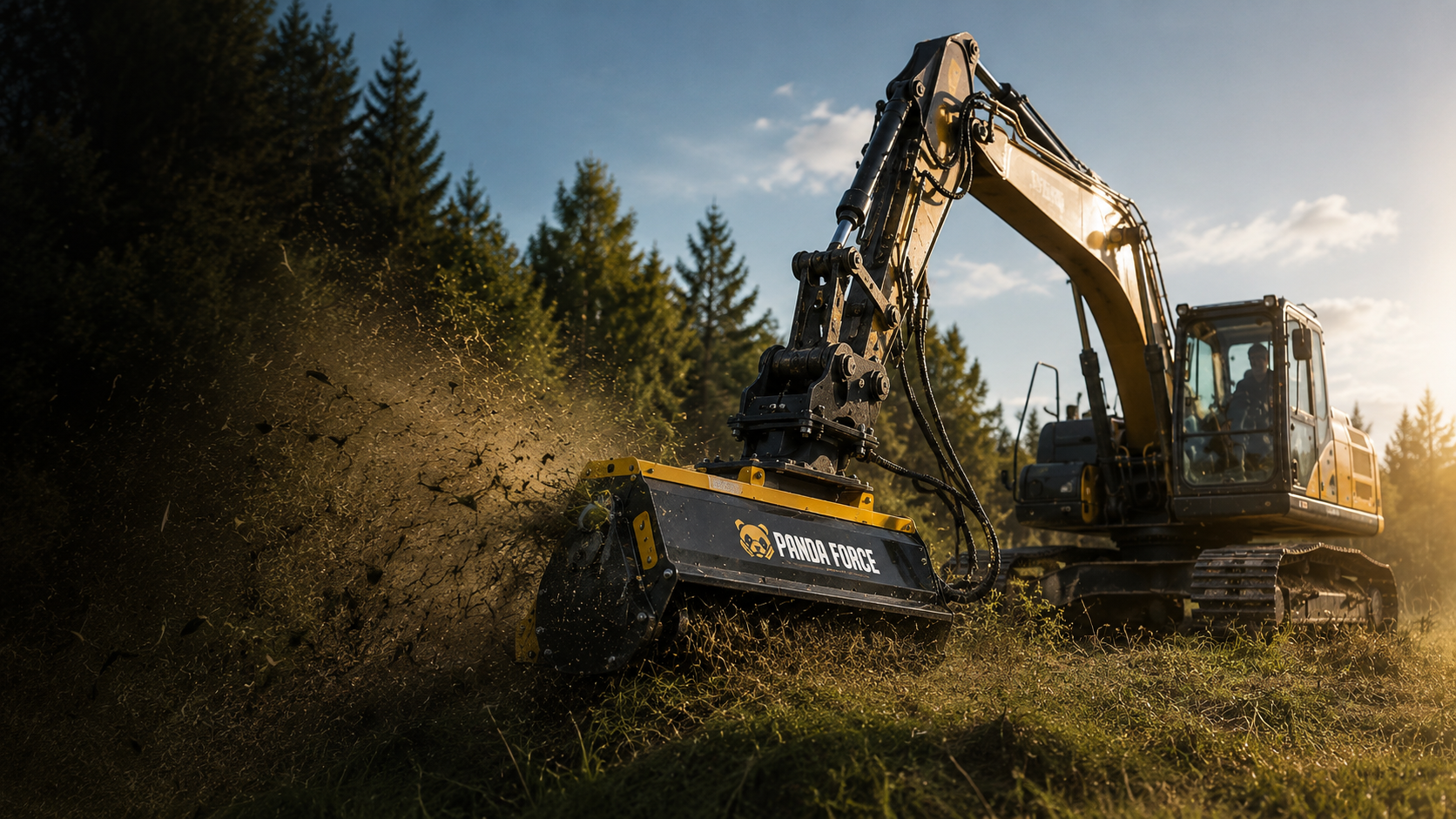
Roadside & Highway Verge Maintenance
Excavator flail mower solutions for highway authorities, civil contractors and infrastructure maintenance teams managing motorway verges, rural road margins and embankments.
PANDA FORCE · SOOSAN Manufacturing · CE Marked · ISO 9001
Application Overview
Why Excavator Flail Mowers Are the Standard for Highway Vegetation Management
Roadside and highway verge maintenance is one of the highest-volume applications for excavator-mounted flail mowers globally. Highway authorities in Europe, North America and Australia specify excavator flail mowers as the primary tool for motorway embankment mowing, rural road margin management and crash barrier base clearance — and for good reason.
The combination of excavator reach (typically 5–9 metres from the machine centreline), precise arm positioning and the mulching action of a flail mower makes it uniquely suited to the challenges of roadside vegetation management. Steep embankment faces, drainage channels, crash barrier bases and restricted-access areas that are inaccessible or dangerous for wheeled machinery are all within the working envelope of a 10–20 tonne excavator with a PANDA FORCE flail mower attachment.
Unlike tractor-mounted flail mowers, an excavator-mounted attachment does not require the machine to travel on the embankment face or in the drainage channel. The excavator works from the carriageway or a safe working platform, extending the arm to reach the vegetation. This eliminates the risk of machine rollover on steep banks — one of the most significant causes of serious injury in roadside maintenance operations.
PANDA FORCE flail mowers are manufactured by SOOSAN Heavy Industries Co., Ltd. in South Korea to ISO 9001:2015 quality standards. All models are CE marked to the EU Machinery Directive 2006/42/EC and are supplied with a full Declaration of Conformity. The range covers working widths from 600mm to 2,000mm and excavator weight classes from 5 tonnes to 35 tonnes, making it possible to specify the correct model for any roadside maintenance programme.
The mulching action of a flail mower — as opposed to a rotary disc cutter or brush cutter — is particularly important in roadside applications. Cut material is reduced to fine particles that fall back onto the embankment face, eliminating the need for secondary collection and disposal. This is a significant cost saving on large highway maintenance contracts and eliminates the fire risk associated with cut material left on embankment faces during dry conditions.
Typical Working Conditions
Product Recommendation
Recommended PANDA FORCE Models
The following PANDA FORCE flail mower and brush cutter models are recommended for this application based on working width requirements, excavator weight class, hydraulic specification and blade type.
PANDA FORCE PF-EFM Excavator Flail Mower
PrimaryThe PF-EFM is the primary specification for roadside maintenance. The 1,200mm and 1,500mm working widths are the most commonly specified for motorway verge work. Y-blade for fine grass; hammer flail for mixed scrub and woody growth on embankment faces.
View Full SpecificationPANDA FORCE PF-HFM High-Flow Flail Mower
Specified where high-flow auxiliary circuits are available and vegetation density is high. The high-flow motor maintains rotor speed on dense embankment growth without stalling — critical for productivity on large highway contracts.
View Full SpecificationPANDA FORCE PF-HDF Heavy Duty Flail Mower
For major highway contracts requiring maximum productivity. The 2,000mm working width significantly reduces the number of passes required on wide motorway verges. Specified for large excavators on major infrastructure projects.
View Full SpecificationBlade Selection
Recommended Blade Types
Y-blade is the standard specification for roadside grass and light scrub maintenance. High tip speed (70–90 m/s) produces fine mulch from grass and light vegetation. Suitable for the majority of routine highway verge maintenance operations. Replace when cutting quality degrades — typically 300–600 ha depending on vegetation density.
Hammer flail is specified where vegetation includes woody growth, saplings or dense scrub — common on neglected embankments or where maintenance intervals have been extended. The heavier blade mass handles woody stems up to 80mm diameter. Switch to hammer flail when Y-blade stalls on dense growth.
Knife blades are not recommended for roadside work due to the high risk of stone and debris impact damage. Roadside verges and gravel margins contain significant quantities of stone, grit and debris that will rapidly damage knife blade cutting edges. Use Y-blade or hammer flail for all roadside applications.
Hydraulic Specification
Hydraulic Requirements
Most 10–20 tonne excavators provide 80–140 L/min auxiliary flow, which is adequate for the 1,000–1,500mm PF-EFM models. Verify your excavator's auxiliary flow rate before specifying. High-flow auxiliary circuits (140–180 L/min) are required for the PF-HFM and larger PF-HDF models. Case drain return must be to tank — not to return line — with maximum 3 bar back-pressure.
Real-World Use Cases
Before & After: Contractor Use Cases
The following use cases are based on real contractor and operator scenarios from PANDA FORCE customers across Europe, North America and Australia. Each describes the challenge, the solution specified and the measurable result.
Motorway Embankment Mowing — UK Highways England Framework
A civil contractor operating under a Highways England Area 9 maintenance framework needed to mow 180 km of motorway embankment twice per season. Embankment faces ranged from 1:2 to 1:1.5 gradient, with heights of 3–8 metres. Previous method used tractor-mounted flail mowers working from the embankment face.
Tractor-mounted mowers required the machine to travel on the embankment face, creating rollover risk on steeper sections. Traffic management costs were high due to the slow working speed of tractor-based methods. Several sections were inaccessible to wheeled machinery due to soft ground conditions.
Specified PANDA FORCE PF-EFM-1500 on a 20t excavator working from the hard shoulder with traffic management. 1,500mm working width and 8m arm reach allowed the full embankment face to be mowed from the carriageway without the machine entering the embankment.
Productivity increased from 0.6 km/day (tractor method) to 1.4 km/day. Traffic management duration reduced by 40%. Zero rollover incidents. Mulch output eliminated secondary collection — saving £18,000 per season in disposal costs.
Rural Road Margin Management — French Departmental Roads
A French departmental road authority needed to manage 2,400 km of rural road margins, including drainage ditches, verges and embankments. Vegetation included grass, bramble, blackthorn and occasional saplings up to 60mm diameter.
Existing tractor-mounted equipment could not reach into drainage ditches or work on steep bank faces. Manual cutting was required for ditch banks, adding significant cost. Sapling growth on embankments was not being controlled, leading to progressive deterioration of sight lines.
Specified PANDA FORCE PF-EFM-1200 with hammer flail blades on a 14t excavator. The arm reach of 7m allowed the machine to work from the road surface, reaching into drainage ditches and up embankment faces in a single pass.
Manual ditch bank cutting eliminated — saving €45,000 per season. Sapling growth controlled in a single pass with hammer flail. Overall programme productivity increased by 35%. Drainage ditch capacity improved, reducing road flooding incidents.
Crash Barrier Base Clearance — German Autobahn
A German motorway maintenance contractor needed to clear dense grass and scrub growth from the base of Armco crash barriers along 95 km of Autobahn. Growth had accumulated over several seasons and included woody stems up to 50mm diameter.
Standard verge mowing equipment could not reach under and behind crash barriers. Manual cutting was slow and expensive. Dense growth at barrier bases was creating a fire risk during dry summer conditions and concealing barrier damage.
Specified PANDA FORCE PF-EFM-800 with hammer flail blades on a 10t excavator. The narrow 800mm working width and precise arm positioning allowed the attachment to work close to and under crash barrier bases without barrier contact.
Barrier base clearance completed at 2.1 km/day — 4× faster than manual methods. Fire risk eliminated. Barrier inspection revealed 23 sections requiring repair that had been concealed by vegetation growth. Programme completed within traffic management budget.
Operational Performance
Productivity Benefits
Dual carriageway verge mowing with 1,500mm model on 18t excavator. Productivity varies with vegetation density, embankment height and traffic management constraints.
Flat verge and margin mowing with 1,500mm model. Higher productivity on flat ground compared to embankment face work due to faster travel speed.
Mulching action eliminates cut material collection and disposal. On large highway contracts this represents a significant proportion of total programme cost.
Working from carriageway or safe platform eliminates the machine rollover risk associated with tractor-mounted equipment on steep embankment faces.
Higher working speed and single-pass capability reduces traffic management duration compared to tractor-based methods on equivalent sections.
Mulching action suppresses regrowth compared to cutting and leaving. Some highway authorities have reduced from 3 to 2 cuts per season after switching to flail mulching.
Operator Safety
Safety Considerations
Safe operation of excavator flail mower attachments requires adherence to the operator manual, relevant national regulations and site-specific risk assessments. The following points are specific to this application environment. They do not replace the full safety documentation supplied with each unit.
Traffic Management
- All roadside work requires a traffic management plan compliant with national regulations (UK: Chapter 8; EU: EN 12767; US: MUTCD)
- Minimum exclusion zone of 10m from working attachment to live traffic — increase to 15m for high-speed roads
- All personnel in the exclusion zone must wear high-visibility PPE to EN ISO 20471 Class 3
- Traffic management must be in place before any attachment movement near the carriageway
Projectile Ejection
- Rear deflector must be in good condition and correctly fitted before operation — inspect before each shift
- Minimum 50m exclusion zone behind the attachment for pedestrians and non-essential vehicles
- Do not operate with the attachment facing oncoming traffic unless full lane closure is in place
- Replace rear deflector when worn below minimum thickness — specified in operator manual
Excavator Stability
- Verify excavator stability before working on embankment edges — consult machine manufacturer's load charts
- Do not extend arm to maximum reach on soft or unstable ground near embankment edges
- Outriggers or stabilisers must be deployed where fitted and ground conditions permit
- Reduce working speed on steep embankment faces to maintain machine stability
Underground Services
- Verify location of underground services before working in drainage channels or ditch bases
- Maintain minimum 500mm clearance between attachment and known service locations
- Contact utility companies for service location information before commencing work
- Stop work immediately if unexpected buried services are encountered
Hydraulic Safety
- Allow rotor to come to a complete stop before repositioning attachment or changing work area
- Inspect hydraulic hoses for damage before each shift — replace any hose showing signs of abrasion or damage
- Do not work with hydraulic leaks — stop work and repair before continuing
- Maintain hydraulic oil temperature below 80°C — reduce working speed if oil temperature warning activates
Environmental
- Avoid mowing during nesting season (March–August in Northern Hemisphere) where protected species are present
- Check for bat roosts and bird nests before commencing work on embankments with established scrub
- Prevent hydraulic oil contamination of drainage channels — have spill kit on site
- Comply with local environmental regulations for vegetation management near watercourses
Service & Maintenance
Maintenance Schedule
Correct maintenance is the single most important factor in attachment service life and operating cost. The following schedule is specific to this application environment. Refer to the operator manual for the full maintenance programme and torque specifications.
- Inspect rear deflector condition and fit
- Check all hydraulic connections for leaks
- Inspect flail blades for damage or missing blades
- Check rotor for stone or debris accumulation
- Grease rotor bearing nipples (2 pumps each)
- Check hydraulic hose condition
- Inspect all flail blades and carrier pins for wear
- Check blade retention bolt torque (refer to manual)
- Inspect side wear plates for wear
- Check rear deflector mounting bolts
- Inspect quick coupler interface for wear
- Check hydraulic motor case drain connection
- Replace worn or damaged flail blades
- Inspect rotor drum for cracks or damage
- Check rotor bearing temperature after 30-min run
- Inspect all welds for cracking
- Check hydraulic relief valve setting
- Inspect mounting bracket for cracks or wear
- Full blade set replacement if wear exceeds 20% of original mass
- Rotor dynamic balance check if vibration has increased
- Full hydraulic system flush and filter replacement
- Repaint worn areas to prevent corrosion
- Full inspection and service record update
- Check CE marking label condition and legibility
Technical FAQ
Frequently Asked Questions
Technical questions specific to this application. For general product questions, visit the individual product pages or the Knowledge Center.
PANDA FORCE Product Range
Excavator Flail Mower & Attachment Range
PANDA FORCE manufactures six excavator attachment models covering every weight class from 1.5 to 50 tonnes. Each product page includes full specifications, hydraulic requirements, compatible excavator brands and blade selection guides.
Ready to Specify for Roadside & Highway Verge Maintenance?
Contact our technical sales team for a model recommendation, compatibility check and competitive quote for your application.